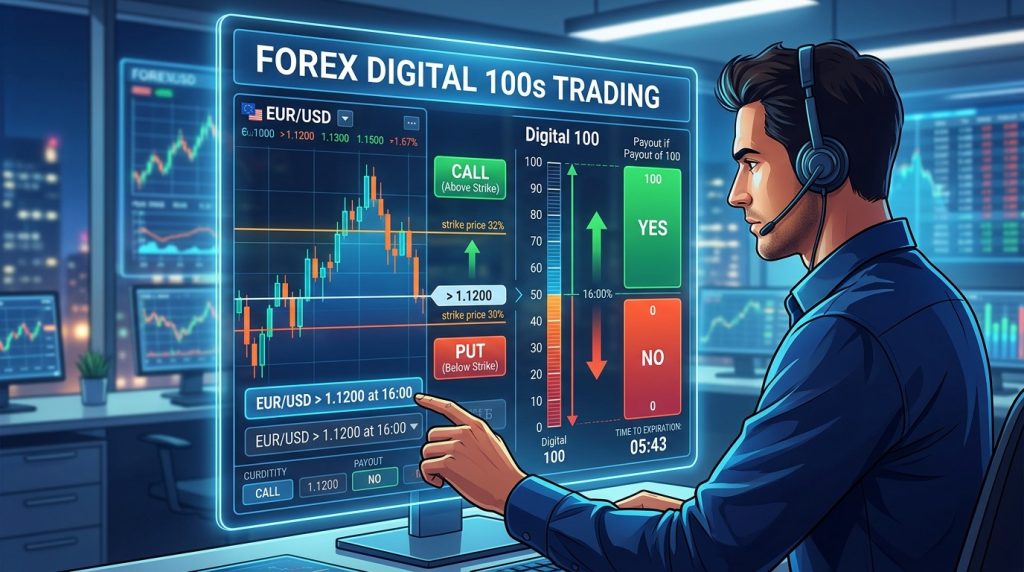
Forex based Digital 100s are fixed payout derivatives linked to a currency pair outcome at a set expiry. The structure is usually framed as a yes or no market statement. Examples include whether EUR/USD will be above a stated level at expiry, or whether a pair will touch a barrier before expiry. If the statement is true at settlement, the contract settles at 100. If false, it settles at 0 in the standard binary style version. IG describes Digital 100s as yes or no contracts priced between 0 and 100, with pricing influenced by time to expiry, the underlying market level, expected volatility, and supply and demand.
In practical terms, this is very close to binary options, and the product category has often been discussed that way, including by market participants and industry coverage. The difference for a trader is usually platform naming, contract format, and available contract types rather than a completely different payoff logic.
Forex traders are often drawn to Digital 100s because the payoff is defined at entry and the contract is easy to understand at the surface. The hard part is not understanding the yes or no statement. The hard part is pricing probability better than the dealer often enough to overcome the built in edge, while managing expiry timing and short term noise. That is where most accounts break down.
How forex Digital 100s work in practice
Contract structure and what you are actually trading
A forex Digital 100 contract is not spot forex ownership and not a standard spot position with stop loss and take profit. It is a priced probability style contract linked to an event on a currency pair. The price is quoted between 0 and 100. In a simplified framing, if you buy at 38 and the event settles true at expiry, settlement is 100 and the gross profit is 62. If the event settles false, settlement is 0 and the gross loss is 38. If you buy at 72 and the event settles true, your gross profit is only 28, while the loss if wrong is 72.
That payoff asymmetry is not a bug. It is the whole contract. When the market thinks the event is likely, you pay more. When it thinks the event is less likely, you pay less. Your edge, if any, comes from judging that the dealer price is wrong enough to justify the trade.
Some providers also allow selling the contract, which flips the payoff logic. In that case, you are effectively shorting the event probability. The same basic point remains. You are trading price versus probability, not just direction.
Expiry and settlement are the center of the product
Expiry is what makes a Digital 100 trade different from normal forex trading. With spot or CFDs, you can often hold while your thesis develops, subject to margin and financing. With a digital contract, the result is forced at a fixed time. Being correct on direction but late on timing can still produce a full loss.
That timing feature matters more than most traders expect. In forex, price can move sharply before a data release, reverse during the release, then drift back in the original direction later. A Digital 100 contract only cares what happened relative to the contract condition and expiry rules. A decent directional read can still fail because the contract did not survive the path.
IG’s own materials describe Digital 100s as being priced from 0 to 100 and linked to expiry specific outcomes, with some markets offering short expiries and others longer dated structures. For a trader, the expiry is not a technical detail. It is the trade thesis.
The trade lifecycle before expiry
Digital 100s can often be traded before expiry, so the position value changes over the life of the contract rather than only at settlement. During that period, the price moves with the underlying pair, time decay effects, changing volatility expectations, and dealer pricing adjustments. Industry explainers describing digital style contracts note that the contract can trade before expiry and the value reflects changing probability of finishing in the money.
This is the part that catches many forex traders. They assume a digital position behaves like leveraged spot. It does not. Delta can change quickly as price approaches the strike or barrier, and time can hurt or help depending on where spot is relative to the contract condition. You can be right on direction and still see the contract price lag if volatility compresses or if the move happens too slowly.
In plain terms, a Digital 100 trade is part directional call, part timing call, and part volatility call, even if the platform interface makes it look like a simple up or down button.
What actually drives the price before expiry
Spot level and distance from the contract condition
The first driver is the current spot level of the forex pair relative to the contract strike or barrier condition. If the event becomes more likely based on price movement, the Digital 100 price usually rises for buyers of that event. If the event becomes less likely, the price falls.
This sounds obvious, but the relationship is not always linear. Small spot moves can produce large contract price changes when the market is near a decisive level close to expiry. The same spot move can do almost nothing when the contract is far out of the money with little time left or far in the money with outcome nearly priced in.
That is why traders who think in “pips only” often misread digital pricing. In spot forex, ten pips always means ten pips. In a digital contract, the same ten pips can imply a very different probability change depending on time and location.
Time to expiry and the compression problem
IG’s descriptions explicitly include time to expiry as a pricing input for Digital 100s. Time matters because probability collapses into reality as expiry approaches. If your event is currently not happening and time is running out, the contract can lose value quickly even if spot is not moving much. If your event is currently happening close to expiry, the contract can move toward 100 rapidly because there is less time for reversal.
For forex traders used to holding through normal intraday noise, this can feel unfair the first few times. It is not unfair. It is just the product doing exactly what it does. The contract is a probability instrument, and time removes optionality.
This creates a common error. Traders buy cheap out of the money digitals late in the session because “it only needs one push,” then repeat that trade often because the ticket size looks small. That is usually a low quality process unless they have a real edge in event timing.
Volatility expectations and why direction alone is not enough
IG also states that expected future volatility is part of Digital 100 pricing. This matters because probability depends not only on where spot is, but how much the market is expected to move before expiry. A contract can become more expensive even without a large spot move if expected volatility rises and the event becomes more plausible within the remaining time.
For forex based Digital 100s, volatility changes around central bank decisions, CPI releases, payroll data, and surprise headlines can be decisive. A trader who ignores volatility is not really pricing the contract, they are guessing direction and hoping the timing matches.
This is why strong digital traders, where they exist, tend to think in scenarios and probability rather than simple chart patterns. They are asking whether the displayed price overstates or understates the true chance of settlement at 100.
Dealer pricing and supply demand effects
IG’s materials also note that Digital 100 prices are set by its dealing desk and influenced by supply and demand or client sentiment depending on jurisdictional product page wording. That means the platform is not just passively displaying a pure theoretical probability. There is a dealer layer.
For traders, this means two practical things. First, the quote can reflect dealer risk management, not just the underlying forex pair. Second, pricing in fast markets can feel less predictable than spot forex because the dealer is managing an options style book under stress.
That does not automatically mean pricing is unfair. It means the trader should stop pretending they are trading a frictionless probability instrument. They are trading a packaged retail derivative with a dealer on the other side.
Trading use cases and setup logic
Event driven forex trading is the most natural use case
If a forex trader insists on using Digital 100s, event windows are usually the most coherent use case. A contract with a defined expiry can match a defined macro catalyst. For example, a trader may have a view that a central bank statement will produce enough volatility for a pair to test a level before a given time. A touch or one touch style contract, where available, can express that view more directly than spot in some situations. IG product pages reference FX digital 100 ladders and one touches on selected currency pairs.
The reason this is a more coherent use case is simple. The product itself is time boxed. Event trades are also time boxed. At least the product structure and the thesis are speaking the same language.
The weak version of this approach is trading every event because “news moves price.” The stronger version is trading only events where the market’s expected move appears mispriced relative to the contract quote.
Range and pinning views can be expressed, but timing still dominates
Digital contracts can also express a range or pinning view, such as a belief that a pair will remain below a level into expiry or fail to reach a barrier. This can look attractive in quiet sessions when spot is stable and volatility is compressing.
The problem is that quiet sessions turn into active sessions without much warning in forex. A data headline, central bank comment, or broader risk move can reprice the pair quickly. Since the contract outcome is binary at settlement, a late move can erase an otherwise “good” read of most of the session.
This is why range views in digitals can produce a false sense of skill. The win rate may look high for a while, then one bad session removes a chunk of prior gains. That pattern is common in fixed payout products.
Directional views are the weakest use unless pricing is clearly wrong
Many traders use Digital 100s as if they were just short term directional bets on EUR/USD or GBP/USD. That is usually the weakest use case because direction alone is not enough. You also need the right timing and a favorable price.
If you simply think “EUR/USD will go up,” spot or CFD trading already expresses that view without forcing an all or nothing expiry. A digital contract only improves the setup if the priced probability is materially in your favor or if the fixed risk feature solves a real risk management problem for your process.
Without that, the trader is paying for product simplicity while accepting worse payoff geometry.
Risk, expectancy, and bankroll math
Frequent wins do not guarantee positive expectancy
Forex based Digital 100s can produce many small or moderate wins, especially when traders buy contracts priced low and take profits before expiry, or when they repeatedly sell contracts that look overpriced. The problem is not win rate by itself. The problem is expectancy after pricing and friction.
If a trader repeatedly buys contracts with weak value, even a decent hit rate can still lose over time because the losses are large relative to gains when price paid is high. If the trader repeatedly buys cheap contracts hoping for low probability moves, the win rate may be too low to recover the total stake losses.
This is basic expectancy math, but in digital products the platform design hides it well because the trade ticket looks simple and the outcome is emotionally clean.
Bankroll damage happens faster than many forex traders expect
Spot forex traders often think in percentage stop loss per trade. Digital traders often think in stake size. That shift sounds minor, but it changes behavior. A stake can feel small and harmless, which encourages repetition. Repetition plus negative expectancy is the whole problem.
A losing streak in Digital 100s is normal, not exceptional. If sizing is aggressive, recovery becomes difficult because each new trade faces the same pricing disadvantage and the account base is smaller. The product can be “limited risk” per trade while still being high risk for the account path.
This is one reason the product tends to attract short horizon behavior that looks more like bankroll gaming than professional risk taking, even when the trader is convinced they are using technical analysis.
The path to positive expectancy is narrow
A trader can, in theory, make money in forex based Digital 100s if they consistently identify mispriced probabilities, manage size tightly, and avoid impulsive high frequency trading. That is a narrow path because it requires competence in probability estimation, volatility judgment, and execution timing at the same time.
Most retail forex traders are trained to think direction first, then stop and target. Digital 100s demand a different mental model. You are pricing an event. If the trader does not fully switch models, the product usually punishes them.
Execution and market conditions
Fast markets expose the weakness of retail digital trading
Execution quality matters in all trading, but in Digital 100s it matters in a more awkward way because the product is dealer priced and the payoff is capped. In fast forex conditions, price updates, spreads, and available contract quotes can shift quickly. IG’s public materials also make clear the dealer desk role in pricing.
That means traders can face a bad combination in volatile moments: wider effective pricing, harder timing, and binary settlement risk. The same event that creates opportunity also increases the chance that the quote is less favorable than the trader assumes. For short expiry trades, that can be enough to turn a decent idea into a bad trade.
Expiry timing is an execution decision, not a detail
Many losing digital strategies are not wrong on direction, they are wrong on expiry selection. The trader is effectively overpaying for immediacy. In forex, where noise is constant, very short expiries can turn a broad edge into coin flip outcomes. If the trader insists on using digitals, expiry choice is one of the biggest risk controls available.
Regulatory and suitability issues
Forex based Digital 100s also need to be viewed through the regulatory history of binary options. The FCA permanently banned the sale, marketing, and distribution of binary options to UK retail consumers in 2019. Industry reporting and market commentary continue to note that binary style products remain restricted for retail in several contexts, with Digital 100s often discussed as a binary style category.
That does not automatically make every Digital 100 product illegitimate everywhere. It does mean traders should treat availability as a regulatory and suitability question, not just a strategy choice. If a product is restricted for retail in major jurisdictions, that is a signal about observed consumer outcomes and product risk, not just a paperwork issue.
For forex traders with basic knowledge, the more useful default is usually spot or standard derivatives with transparent risk rules and less binary payoff pressure. Digital 100s can be studied as a niche event instrument, but they are a poor substitute for a sound forex trading process.
Forex traders are usually best of ny selecting a forex broker regulated by their local regulator or a well regulated international forex broker.
Closing remarks
Trading forex based Digital 100s is not just “forex but simpler.” It is a different product with a probability priced quote, forced expiry, capped payoff, and dealer pricing inputs. IG’s own descriptions of Digital 100s pricing and structure make that clear.
A trader can use these contracts in a disciplined way, especially for narrowly defined event views, but the bar is higher than most people assume. You need to be right on direction, timing, and price relative to true probability. Miss one of those consistently and the maths starts working against you.
That is why many forex traders are better served treating Digital 100s as a specialist instrument, not a default trading method. The product looks clean on the ticket. The risk profile is not.
This article was last updated on: March 5, 2026